Spanish Immersion
How Children Learn a Second Language Without Translation
Learn how children learn a second language through play, routines, relationships, and meaningful Spanish immersion at a Woodbury, Minnesota preschool.
Lucilla Davila
Founder
Understanding how children learn a second language can feel almost magical. A teacher speaks Spanish, a child begins with little or no Spanish, and soon that child follows directions, joins songs, and uses new words. The process is not built on translating every sentence. It is built on meaningful experiences that help children connect what they hear with what is happening around them.
At Alma Flor Ada, our Spanish immersion approach gives children time to hear, understand, practice, and use Spanish during a real school day. Play, routines, movement, stories, and caring relationships give the language a purpose. Children are not memorizing disconnected vocabulary. They are learning what words mean because those words help them participate.
How do children understand Spanish without word-for-word translation?
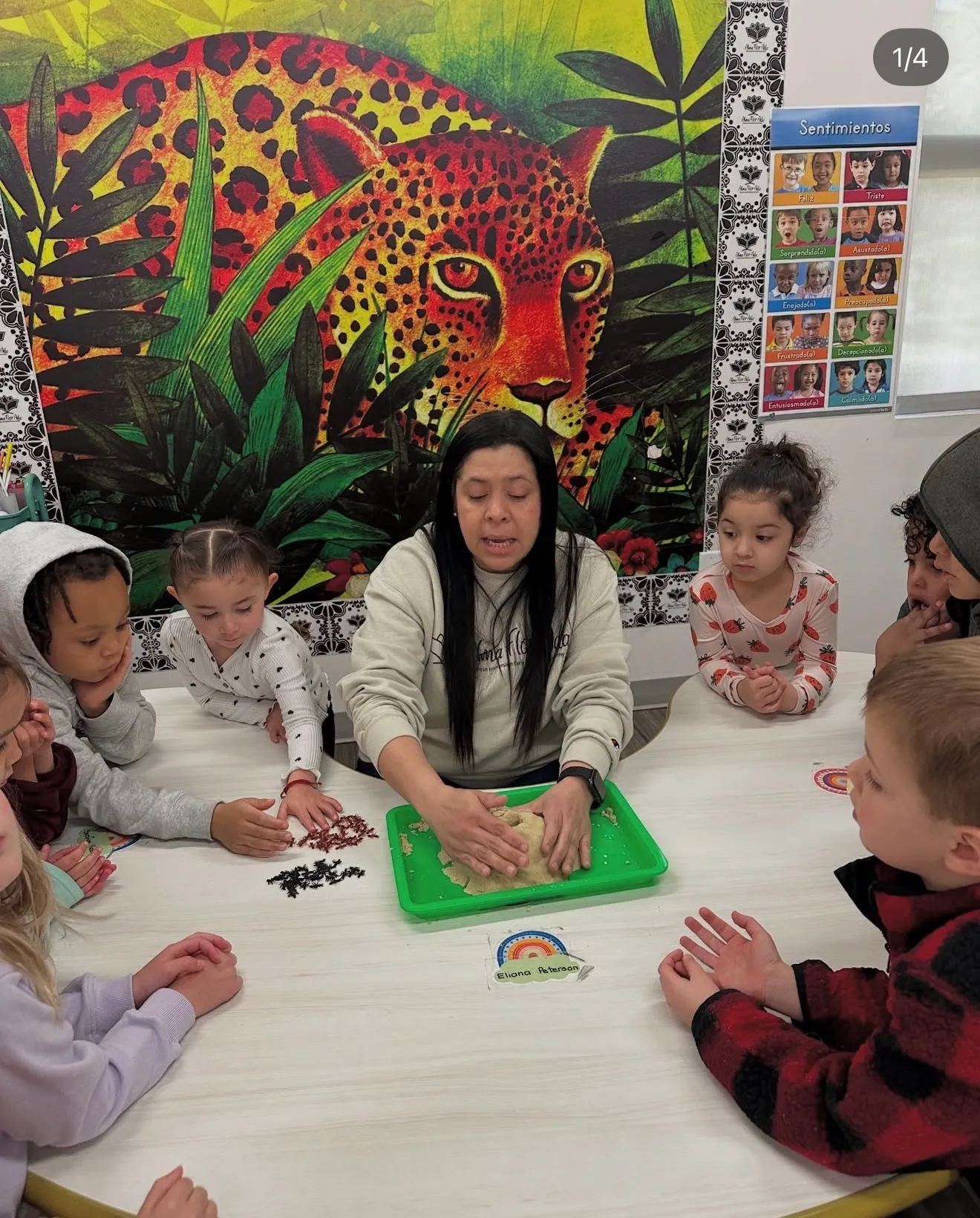
Children understand a new language when adults make its meaning visible. Teachers pair words with gestures, facial expressions, objects, pictures, tone of voice, and actions, so a child has several clues at once.
Imagine a teacher holding up a paintbrush and saying, “Toma el pincel,” while gently offering it to a child. The object, the movement, and the moment explain the phrase. The child does not need a spoken English definition before reaching for the brush.
Early childhood educators often call understandable language like this comprehensible input. The term sounds technical, but the practice is natural. Head Start guidance for home visitors working with dual language learners recommends using gestures, body movement, and visual supports to help young children connect language with meaning.
Why are routines so powerful for language learning?
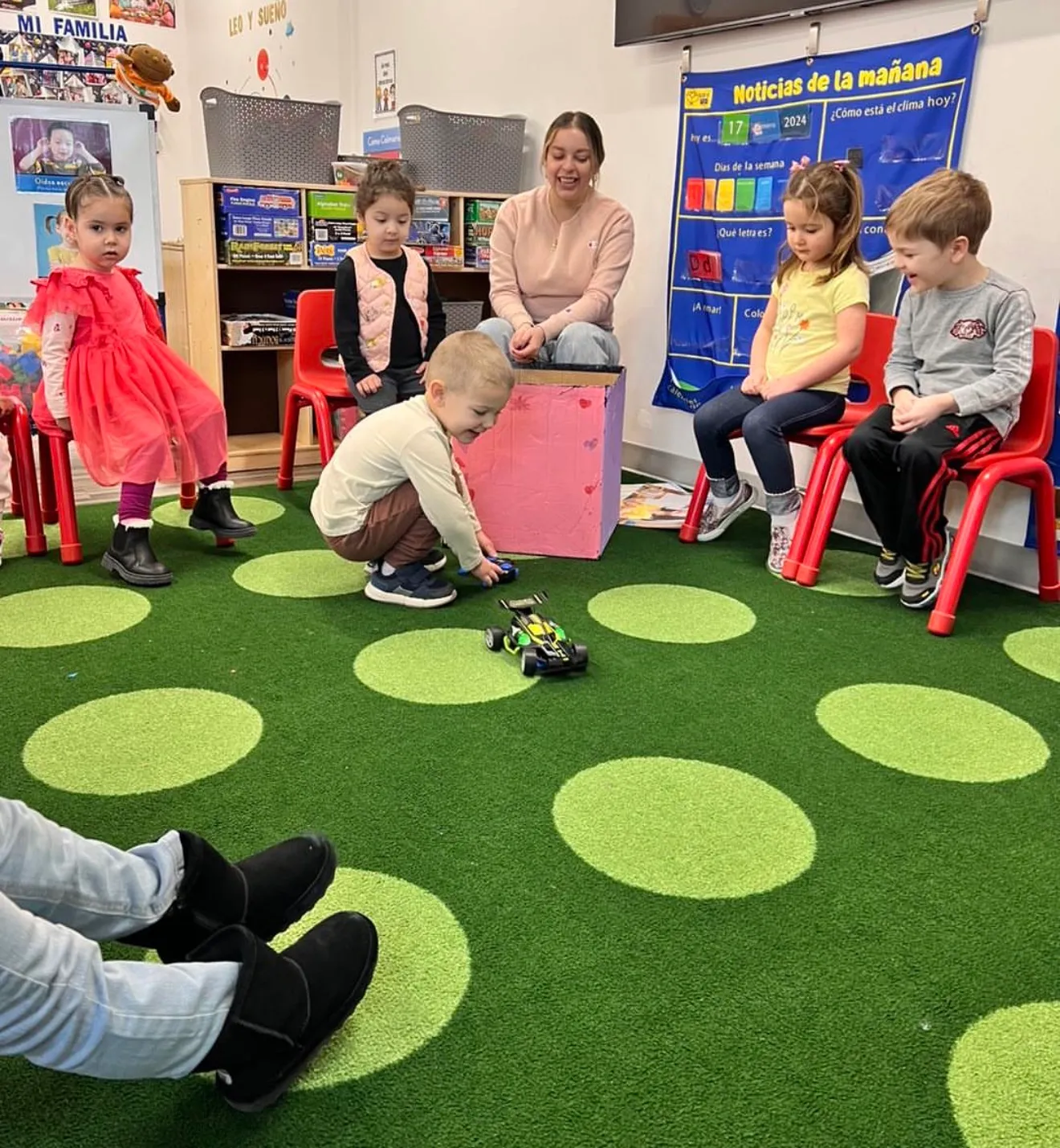
Routines give children repeated language in a predictable context. When the same useful words accompany the same action each day, children can test their understanding and build confidence.
Handwashing is a simple example. A child may hear phrases for turning on the water, using soap, rinsing, and drying at the same point every day. The sequence stays familiar even while the words are new. After enough repetitions, the language becomes part of the routine.
The same process happens during:
- Morning greetings and putting away belongings
- Snack and mealtime conversations
- Cleanup cues and classroom transitions
- Songs with repeated words and motions
- Story time with pictures and familiar patterns
- Outdoor play and hands-on projects
This is one reason immersion is more than a vocabulary lesson. Spanish becomes the language children use to move through their day. Our guide to the 90/10 Spanish immersion model explains how that consistent environment supports learning.
What does learning look like before a child starts speaking?
Understanding usually becomes visible before fluent speech does. A child may respond correctly to a direction, point to an object, bring a requested item, follow a classmate’s movement, or join the motions of a song before saying the words independently.
Those responses matter. They show that the child is connecting sound with meaning and building receptive language. Speaking is only one form of participation.
A quiet child may be doing a great deal of mental work. They are noticing repeated sounds, watching what other people do, and learning which phrases belong to which moments. Giving that child time reduces pressure and keeps communication safe. Teachers can invite a response without demanding a performance.
Why do play and hands-on learning help?
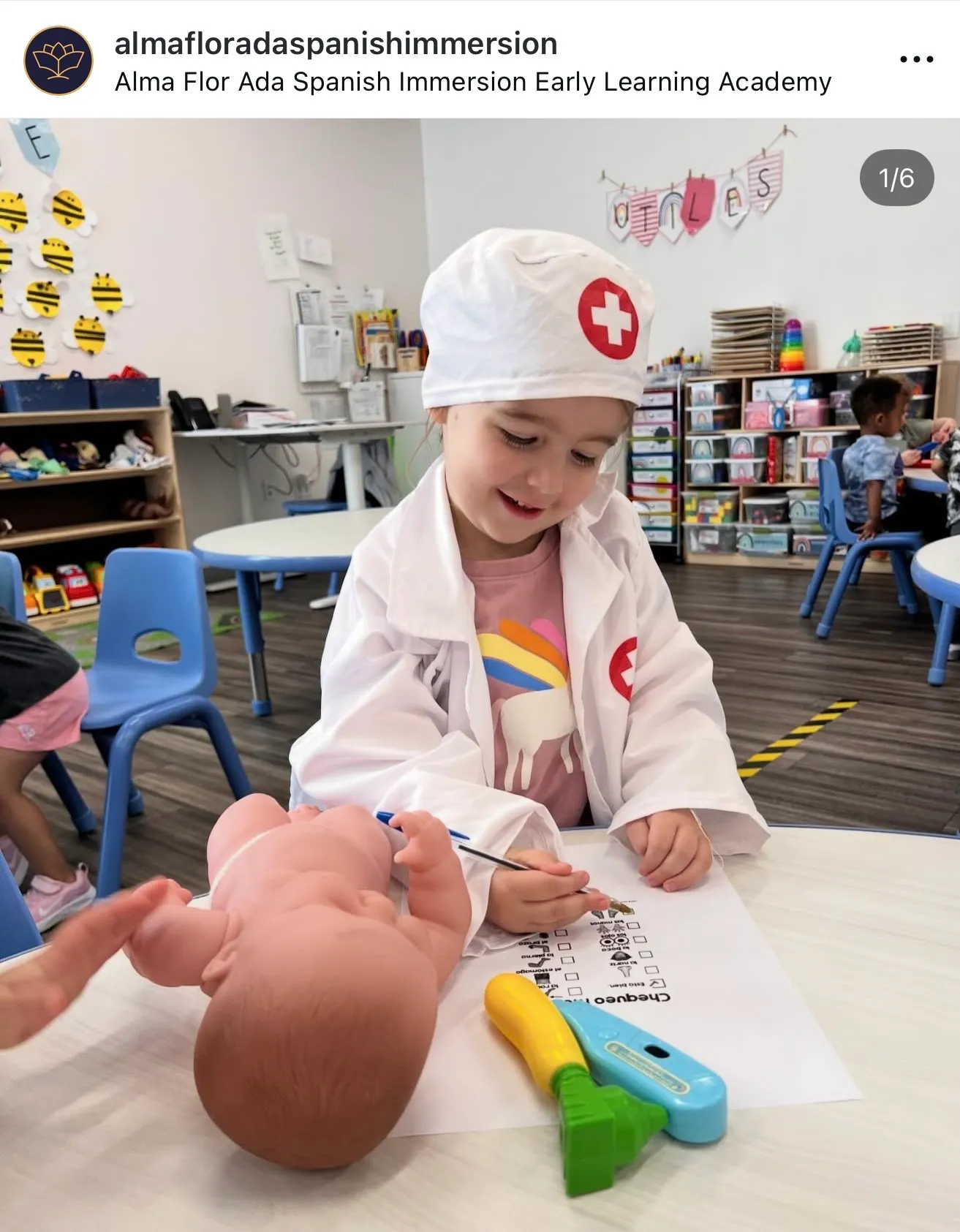
Play gives language an immediate purpose. Children need words to choose materials, solve a problem, take turns, describe what they notice, and join friends. Meaning comes from the shared activity.
During a sensory project, for example, a teacher can name colors, textures, actions, and quantities while children touch and move the materials. During dramatic play, children hear language tied to roles, objects, and social exchanges. Songs add rhythm and repetition. Picture books connect spoken words with images and a story children can follow.
These experiences also let teachers repeat useful language without making the repetition feel like drilling. A phrase can appear in a story, a game, a classroom routine, and a conversation. Each new context strengthens the connection.
Do teachers ever use English?
Yes, when clarity, safety, or emotional reassurance calls for it. Avoiding constant translation does not mean leaving a child confused or distressed.
In a 90/10 model, Spanish remains the main language of the day, while English can serve as a brief bridge when a child needs help understanding something important. The goal is not to prove that a classroom can avoid English at all costs. The goal is to give children enough meaningful Spanish that they learn to understand it directly.
Teachers also watch closely for nonverbal signs. A puzzled expression, hesitation, or change in behavior can signal that a child needs another visual clue, a slower phrase, a demonstration, or brief reassurance. Responsive teaching keeps the challenge appropriate and the relationship secure.
Is it normal for children to mix languages?
Yes. A child learning more than one language may use an English word in a Spanish sentence, apply a familiar pattern from one language to the other, or choose the word that comes fastest. This does not mean the child is confused.
The American Academy of Pediatrics explains that mixing words or grammar can be a normal part of multilingual development. Children are using all the communication tools available to them. With continued experience, they become more skilled at choosing the language that fits the person and setting.
Adults can respond to the meaning first, then model the phrase naturally. The conversation stays warm while the child continues hearing clear language.
What can families do if they do not speak Spanish?
Keep using the language your family speaks most comfortably. Rich conversation, stories, songs, and play at home support communication overall. A strong home-language foundation does not compete with Spanish learning at school.
You can also help by staying curious without quizzing. If your child shares a Spanish word, enjoy the moment. If they are not ready to perform a song for relatives, let that be okay. Language grows through connection and practice, not pressure.
If you would like to see how gestures, routines, relationships, and play make Spanish understandable, schedule a tour of our Woodbury academy. Watching an immersion classroom in motion often makes the learning process clear.
Frequently Asked Questions
How can children understand a second language if no one translates?
Is it normal for a child to listen before speaking Spanish?
Will learning Spanish confuse a child who speaks English at home?
What can families do at home if they do not speak Spanish?
About the author
Lucilla Davila, Founder
Lucilla Davila is the founder of Alma Flor Ada Spanish Immersion Early Learning Academy. She built AFA to create the kind of nurturing, joyful, culturally rooted Spanish immersion environment she searched for as a parent and could not find. She leads the academy's vision of raising bilingual, kindhearted, kindergarten-ready children in Woodbury.
Curious about Spanish immersion for your child?
Schedule a tour of our Woodbury academy. We would love to show you around and answer your questions.