Bilingual Parenting
Nurturing Language Skills from Toddler to Preschooler
How young children's language develops from toddler to preschooler, the milestones to watch, and how immersion supports every stage of growth.

Lucilla Davila
Founder
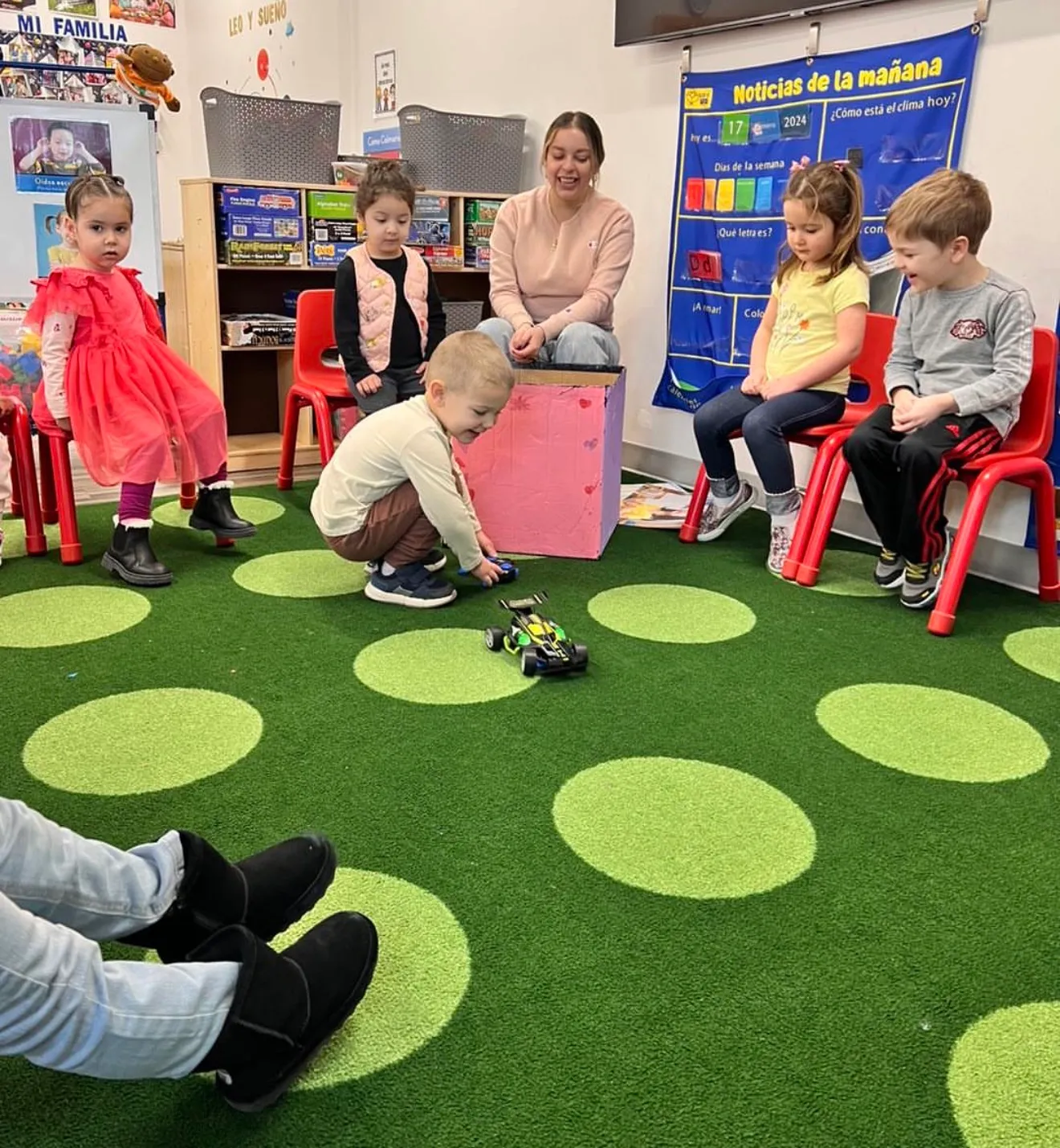
Why Language Development Preschool Matters More Than You Think
Language development preschool is the critical period when children ages 3-5 rapidly expand their vocabulary, master grammar, engage in complex conversations, and build communication skills that are the foundation for all future learning. Understanding these stages helps parents and educators provide the right support.
Key Language Development Milestones for Preschoolers:
- Age 3: Uses 3-4 word sentences, asks “Why?” frequently, vocabulary of 200+ words
- Age 4: Uses 5-6 word sentences, tells simple stories, understood by most adults
- Age 5: Carries on adult-like conversations, uses 2,000+ words, defines simple words
Language development is a remarkable process that begins long before your child enters preschool. From the first babbles to fully formed sentences, the preschool years represent an explosion of communication skills. By age 5, children’s language abilities approach those of adults, a testament to the incredible learning that happens during these early years.
The first five years of life are when the brain is most receptive to language learning. Children absorb new words at an astonishing rate, master complex grammar rules (often making charming mistakes), and learn to use language for increasingly sophisticated purposes, from asking questions to telling stories to expressing their feelings.
Parents and educators play a crucial role in this journey. Every conversation, every story read aloud, and every question answered plants seeds for future literacy and academic success. The good news? The most powerful strategies for supporting language development are often the simplest: talking, listening, reading, and playing together.
I’m Lucilla Davila, and I’ve spent nearly three decades advancing language acquisition and bilingual education, with deep expertise in dual immersion models and ESL programs. Throughout my career, language development preschool has been at the heart of my work, understanding how young children build communication skills and designing environments that honor their linguistic and cultural identities. In this guide, I’ll walk you through the developmental stages, practical strategies, and key insights to help preschoolers become confident communicators.
The Blueprint of Speech: Key Language Milestones for Preschoolers (Ages 3-5)
Watching preschoolers grow into confident communicators is one of life’s great joys. From their blossoming vocabulary to their increasingly complex sentences, the years between three and five are a period of immense linguistic growth. During this time, children learn to use language to steer their world, express their thoughts, and connect with others.
This stage is marked by a vocabulary explosion, a dramatic increase in sentence complexity, and the fascinating process of grammar development. They’re also refining their conversational skills and tackling some common pronunciation challenges. Let’s dig into these exciting developments.
| Age Range | Vocabulary & Sentence Structure | Conversational Skills | Pronunciation & Grammar |
|---|---|---|---|
| 3-4 Years | Forms 3-4 word sentences; Asks “Why?”, “What?”, “Where?” questions; Uses “because,” “and,” “if”; Understands more detailed instructions. | Tells simple stories (may need prompting); Expresses feelings; Asks many questions; Follows 2-step familiar instructions. | Makes grammar mistakes (e.g., “runned”); May struggle with ‘l’, ‘r’, ‘th’ sounds; Mostly understood by familiar people. |
| 4-5 Years | Forms 5-6+ word sentences; Uses complex sentences with conjunctions; Defines simple words (e.g., ‘spoon’); Vocabulary of 2,000+ words. | Carries on conversations; Stays on topic; Talks about past/future events; Develops a sense of humor; Understands jokes. | Pronounces most sounds correctly (90% intelligible to strangers); Occasional struggles with ‘th’, ‘ch’, ‘j’, consonant blends; Grammar errors become less frequent. |
Typical Stages of Language Development for Preschoolers
The journey of language development preschool is dynamic, with distinct leaps in ability between ages three and five. While every child develops at their own pace, these milestones provide a general roadmap.
At age 3, children are truly finding their voice. They often use complete sentences of 3 to 4 words, allowing them to express more complex thoughts than before. This is also the “Why?” age, as they constantly probe the world around them with endless questions, demonstrating their burgeoning curiosity and desire for understanding. Their vocabulary expands significantly, moving beyond simple nouns and verbs to include more descriptive words.
As they transition into age 4, children’s sentences grow longer and more intricate, typically using 5 to 6 words. They begin to weave simple stories, though they might still need a little prompting to keep the narrative flowing. Their speech becomes clearer, and by this age, most adults will understand them, even if some words aren’t perfectly pronounced. This is a great time to encourage their burgeoning literacy skills by exploring resources like the Language and Literacy Development in Early Childhood from PBS Parents.
By age 5, children’s language skills are truly impressive, closer to those of an adult. They can carry on a conversation with another person, staying on topic and contributing meaningfully. Their vocabulary is extensive, and they can even define words like ‘spoon’ or ‘cat’, showing a deeper understanding of language. They are able to use language to reason, predict, and express empathy, laying crucial groundwork for social and academic success.
From Simple Words to Complex Stories
The leap from simple words to complex storytelling is a hallmark of the language development preschool years. We see a significant vocabulary growth, as children learn new words by listening, guessing from context, and through new experiences. They start understanding abstract concepts and using connecting words like ‘because’, ‘and’, and ‘if’, which allows them to build more sophisticated sentences.
Grammar development is also in full swing. Children begin to grasp rules for plurals and past tense, though they often apply these rules strictly, leading to charming overgeneralizations like “runned” instead of “ran” or “foots” instead of “feet.” These “mistakes” are actually signs of their developing understanding of grammar rules! By age 5, these errors become less frequent. For more insights into how we nurture these skills, you can explore More info about our Pre-K program.
Pronunciation also improves dramatically. While 3-year-olds might still make mistakes, these become less frequent by age 5. Common pronunciation challenges often involve sounds like ‘l’, ‘r’, ‘s’, ‘th’, ‘ch’, and ‘j’, or certain consonant blends. For instance, a child might say ‘fank’ instead of ‘thank’ or ‘wiv’ instead of ‘with’. By age 4, most adults will understand them about 90% of the time, even if some sounds aren’t perfect.
Understanding and Conversation Skills
A preschooler’s ability to understand and engage in conversations evolves significantly. They move from understanding simple one-step commands to following multi-step instructions, especially for familiar tasks. They become adept at answering “who, what, where, why, and how” questions, demonstrating their growing comprehension of their world.
Crucially, they learn the unspoken rules of conversation: taking turns, staying on topic, and initiating conversations. They might start a conversation with an excited “Guess what?” or eagerly share thoughts during dramatic play. We see them talking about past and future events, like “Do you remember what we saw at the park yesterday?” or “What are we going to do tomorrow?” This shows their developing understanding of time and narrative.
And perhaps one of the most delightful developments is their burgeoning sense of humor! Children start to understand jokes and appreciate funny situations, indicating a deeper grasp of language and its subtleties. They even begin to understand that people sometimes say things just to be funny, not always literally.
The Parent & Educator Playbook: Everyday Strategies to Nurture Communication
As parents and educators, we are our children’s first and most influential language teachers. The good news is that fostering strong language development preschool skills doesn’t require special equipment or complex curricula. It thrives on everyday interactions, genuine interest, and a language-rich environment.
Our approach is rooted in active listening, consistently modeling correct language, and creating abundant opportunities for children to talk. We focus on responding to their attempts at communication rather than solely correcting them, building their confidence and encouraging them to keep trying.
Fostering Language Through Conversation
Conversations are the cornerstone of language learning. We can significantly boost our children’s language skills by engaging them in dialogue throughout the day. When a child says a single word or a short phrase, we can expand on their utterance, turning “Ball!” into “Oh! Your ball rolled under the chair!” This provides a richer language model without direct correction.
Similarly, when children make grammar mistakes, we respond with correct grammar instead of direct correction. For example, if a child says, “I color orange frog,” we can respond with, “Yes, I see you have colored the frog orange.” This “recasting” gently models the correct structure while keeping the conversation flowing. The key is to build on their ideas, not just their grammar. You can find more helpful tips on stimulating oral language from Speech-Language & Audiology Canada.
Asking open-ended questions (“What do you think will happen next?” or “How did you make that?”) encourages more than a “yes” or “no” answer, prompting them to elaborate and use more descriptive language. Narrating our daily activities (“Now we’re putting on our socks, then we’ll go to the park”) also provides a constant stream of language input. Most importantly, we must give children time to respond. Silence can be golden, allowing them to formulate their thoughts. Listening attentively to their communication attempts validates their efforts and encourages them to communicate more. For more tips, check out Helpful tips for stimulating oral language.
The Power of Reading Aloud and Storytelling
Reading aloud is one of the most powerful tools we have for nurturing language development preschool. It’s not just about the words on the page; it’s about the interaction, the shared experience, and the magic of stories. Shared book reading, where an adult reads to a child or a small group, exposes children to new vocabulary and complex sentence structures they might not encounter in everyday conversation.
Interactive shared book reading takes this a step further, with the adult using various techniques to engage children in the text. We can ask questions about the story (“Why do you think the character is sad?”), encourage them to make predictions (“What do you think will happen next?”), and connect the stories to their own lives. Dialogic reading, in particular, is an interactive shared picture book reading practice where the adult and child switch roles, with the child learning to become the storyteller with the adult’s assistance. This method has shown positive effects on oral language development. You can learn more about this approach through research on Dialogic Reading.
Beyond reading published books, creating original stories together or building on a child’s story ideas is a fantastic way to develop narrative skills and vocabulary. We can encourage them to imagine different endings to familiar stories or tell their version of an event, fostering creativity alongside language.
Using Technology and Media Mindfully
It’s natural to wonder about the role of technology in language development preschool. While excessive screen time for young children is not recommended (Canadian experts advise no screen time for children under 2, and limiting it to an hour or less for 2-4 year olds), technology can be a tool for language enrichment when used mindfully.
The key is to select high-quality educational programs and, crucially, to co-view with your child. This means watching together and discussing the content, asking questions, and connecting what they see to their own experiences. This interaction transforms passive viewing into an active learning experience. For example, if a child is watching a show about animals, we can pause and ask, “What sound does that animal make?” or “Where have we seen an animal like that?”
Technology can also be used for creation, encouraging language expression. Children can dictate stories to an adult who types them on a tablet, or use simple drawing apps to create pictures they then describe. Developing media literacy, which helps children understand and use various media forms, is a crucial component of modern communication development. This involves helping children become aware of what media content makes them happy, sad, or frustrated, and differentiate between reality and fantasy. For more on this, explore Developing Young Children’s Media Literacy.
Beyond Words: The Role of Play, Bilingualism, and Early Literacy
Language isn’t just learned through formal lessons; it blossoms through interaction, curiosity, and play. These elements are especially vital during the language development preschool years, providing rich contexts for children to experiment with words, negotiate meanings, and build foundational literacy skills.
How Imaginative Play Builds Vocabulary
Imaginative play, often called dramatic play or pretend play, is a powerhouse for language development preschool. When children engage in role-playing scenarios, whether they’re being doctors, chefs, or superheroes, they are actively using and expanding their vocabulary. They try out new words in context, mimicking adult speech patterns and experimenting with different tones and expressions.
During play, children express ideas and feelings, negotiate with peers (“No, I want to be the doctor today!”), and create elaborate narratives. This type of play provides a safe space for them to practice social communication, problem-solving talk, and even develop their own unique “play language.” For instance, a child pretending to be a chef might learn words like “sauté,” “whisk,” or “recipe,” integrating them into their play. At Alma Flor Ada Spanish Immersion, our programs, including More info about our Early Pre-K program, are designed to harness the power of play to foster rich language acquisition.
Supporting Bilingual Children and Second Language Learners
At Alma Flor Ada Spanish Immersion, we deeply understand the incredible advantages of bilingualism. For children learning a second language or growing up in a bilingual environment, their language development preschool journey is particularly rich and rewarding. Research shows that infants can learn the rhythm of two languages when both are spoken at home, and a strong foundation in one language readily transfers when learning another.
Bilingualism offers significant cognitive benefits, enhancing problem-solving skills, cognitive flexibility, and even executive functions. It’s common and completely normal for bilingual children to mix languages temporarily, a phenomenon known as “code-switching.” This is not a sign of confusion but rather an efficient use of their full linguistic repertoire. We celebrate this “translanguaging” as a strength, recognizing that it aids understanding and connects schools, families, and communities.
Our 90/10 Model at Alma Flor Ada Spanish Immersion is designed to immerse children in Spanish while building a strong foundation that supports all their language development. We encourage families to support the home language, whether it’s English or another language, as this creates a rich linguistic environment and fosters a positive cultural identity. Patience and encouragement are key; children learning two languages may take a little longer to reach certain milestones in one language, but their overall linguistic and cognitive development is significantly improved.
From Scribbles to Sentences: Emergent Writing
Before children can write coherent sentences, they go through fascinating stages of emergent writing. This journey begins with scribbles that gradually evolve into lines, shapes, and letter-like forms. Crucially, they learn to connect print to meaning, realizing that the marks on a page convey messages. This understanding is often sparked by recognizing familiar brand logos or environmental print like exit signs.
We can foster emergent writing by labeling the environment with both pictures and words, making the connection explicit. Providing diverse writing materials, crayons, markers, different types of paper, makes writing accessible and inviting. Children naturally start writing for a purpose, whether it’s “writing” a grocery list for dramatic play, creating a birthday card, or simply signing their artwork.
Phonological awareness, the ability to hear and manipulate the sounds in words, is a critical precursor to reading and writing. Games that involve rhyming, identifying initial sounds, and blending sounds help children understand the building blocks of language. As they become more aware of letter-sound correspondence, their “scribbles” begin to resemble actual letters and words. For more insights into nurturing these early writing skills, explore Promoting Preschoolers’ Emergent Writing.
Identifying Red Flags in Language Development Preschool
As we celebrate the remarkable growth in language development preschool, it’s also important to be aware of signs that might indicate a potential delay. While every child develops at their own pace, recognizing red flags early allows for timely intervention, which is crucial for positive outcomes.
Signs of Potential Speech or Language Delays
It’s helpful to understand the difference between a speech disorder and a language disorder. A speech disorder affects the physical act of talking, how sounds are produced (articulation) or the flow of speech (stuttering). A language disorder involves difficulty understanding (receptive language) or sharing thoughts, ideas, and feelings (expressive language).
Here are some key red flags to watch for during the language development preschool years:
- By Age 3:
- Not using 3-word sentences.
- Speech is consistently difficult to understand by familiar people.
- Limited vocabulary (fewer than 50 words).
- Doesn’t ask “what,” “where,” “who” questions.
- Doesn’t understand simple commands or questions.
- Doesn’t play pretend games.
- Loses language skills they once had.
- By Age 4:
- Not using 4-word sentences regularly.
- Speech is still difficult to understand by most strangers.
- Trouble following 2-part instructions (especially unfamiliar ones).
- Doesn’t tell simple stories.
- Doesn’t engage in back-and-forth conversations.
- Frequently repeats words or phrases (stuttering that lasts longer than 6 months).
- By Age 5:
- Cannot use sentences of 5-6 words.
- Cannot recall parts of a story.
- Difficulty understanding more complex concepts.
- Has difficulty being understood by others most of the time.
- Shows frustration when trying to communicate.
- Avoids communicating with others.
These are guidelines. Small differences in skill development timing are usually not a cause for concern. However, if you notice several of these signs, or if your child seems to regress in their language skills, it’s wise to seek professional advice.
When and How to Seek Professional Help
If we have concerns about our child’s language development preschool, the first step is always to talk to our pediatrician. They can conduct initial screenings and, if necessary, refer us to a specialist.
A speech-language pathologist (SLP) is the professional who evaluates and treats speech and language disorders. An evaluation by an SLP might involve spoken tests, observation of your child’s communication in play, and possibly a hearing test to rule out any underlying hearing issues. Hearing problems can significantly impact speech and language development, so it’s a crucial step.
Trusting our instincts as parents and educators is vital. If something feels “off,” it probably is. Early intervention is most effective, so don’t hesitate to seek help. An SLP can provide strategies to use at home, recommend individual or group therapy, and offer guidance custom to your child’s specific needs. To find a professional, you can consult organizations that provide referrals to qualified speech-language pathologists, like those referenced by the Ordre des orthophonistes et audiologistes du Québec for a general understanding of where to find such specialists.
Frequently Asked Questions
How should I correct my preschooler's grammar?
Is it normal for my 4-year-old to still mispronounce some words?
How does a Spanish immersion program affect my child's English language development?
About the author
Lucilla Davila, Founder
Lucilla Davila is the founder of Alma Flor Ada Spanish Immersion Early Learning Academy. She built AFA to create the kind of nurturing, joyful, culturally rooted Spanish immersion environment she searched for as a parent and could not find. She leads the academy's vision of raising bilingual, kindhearted, kindergarten-ready children in Woodbury.
Curious about Spanish immersion for your child?
Schedule a tour of our Woodbury academy. We would love to show you around and answer your questions.