Choosing a Preschool
Is Your Child Ready for Kindergarten? A Parent's Checklist
Wondering is my child ready for kindergarten? Use this Woodbury parent's checklist of readiness skills across five key areas, plus what really matters most.

Melissa Thaemert
School Director
If you have a four or five year old at home, you have probably asked yourself the big question: is my child ready for kindergarten? It is one of the most common worries parents bring to us, and it deserves an honest, reassuring answer. Readiness is not about whether your child can already read or write their name in perfect letters. It is about a broader set of skills that help a child feel confident, curious, and comfortable in a classroom. This checklist walks you through what those skills actually are, and what matters most.
The good news is that readiness develops naturally in a warm, engaging early learning environment. You do not need flashcards or drills. You need to know what to look for, and how to support your child in the everyday.
What does kindergarten readiness really mean?
Kindergarten readiness is a child’s overall preparedness to thrive in a structured classroom, and it spans five key areas: social and emotional skills, language and communication, early literacy, early math, and self-care with motor skills. No single skill defines readiness. Instead, teachers look at how a child is developing across all five, knowing that most children are ahead in some and still growing in others.
That last point is worth holding onto. Typical development includes a wide range. A child can be a confident talker who is still learning to hold scissors, or a careful builder who is still learning to separate at drop off. Both are normal. A checklist is a helpful guide, not a pass or fail test.
The kindergarten readiness checklist
Here are the signs of kindergarten readiness, grouped by the five areas teachers watch. Use it as a gentle guide over the coming months.
Social and emotional skills
This is the foundation, and often the strongest predictor of a smooth start. Look for a child who can:
- Separate from a parent without lasting distress
- Follow simple two step directions, like “put your cup away and grab your coat”
- Take turns and share during play, most of the time
- Ask an adult for help when they need it
- Manage transitions from one activity to the next
- Play alongside and with other children
Language and communication
A kindergartner spends the day listening, talking, and following along. Helpful signs include:
- Speaking in full sentences that others can understand
- Following directions given to the group, not just one on one
- Answering simple questions and telling a short story about their day
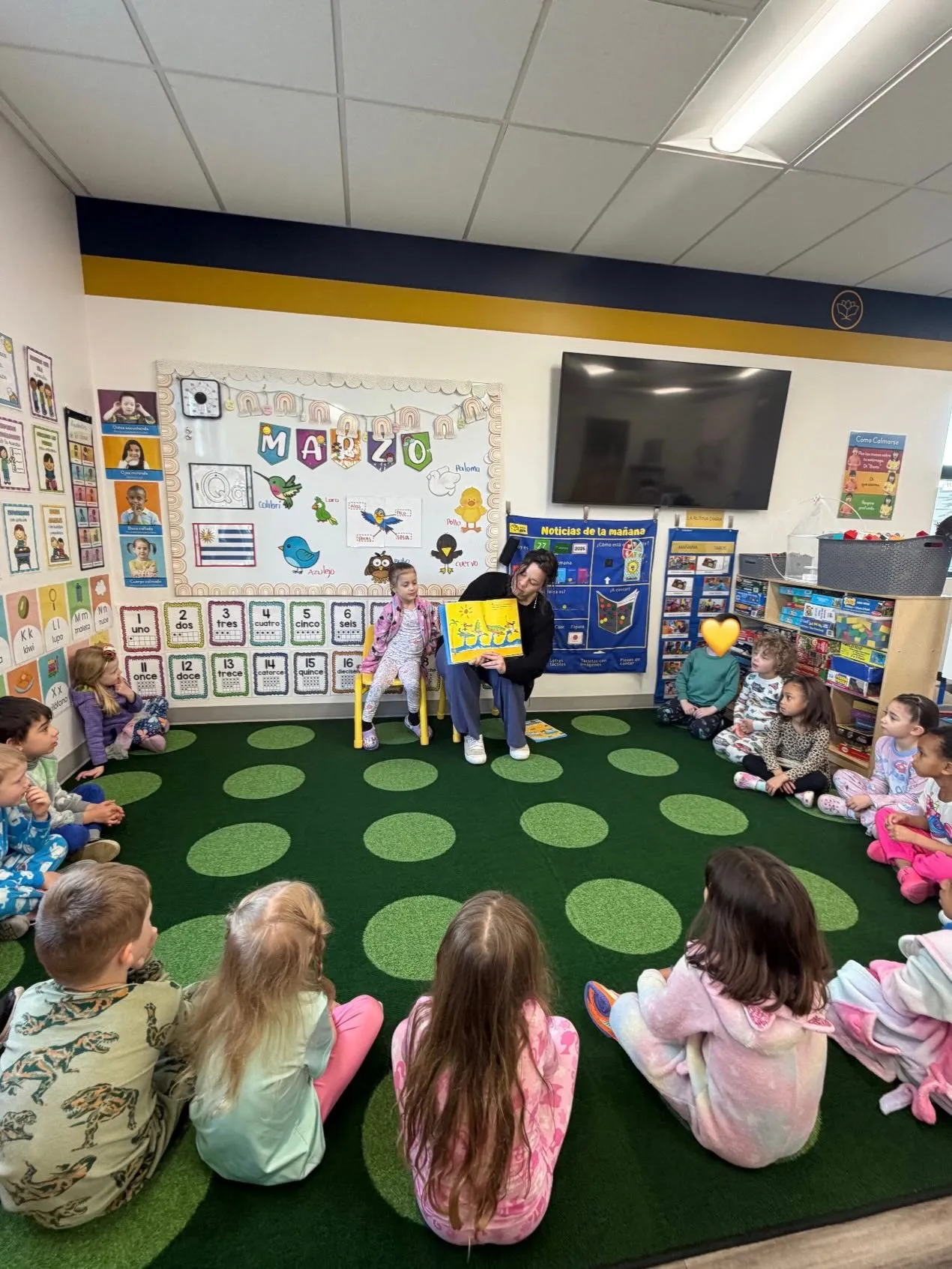
- Listening during a group activity or story time
Early literacy
Reading is a kindergarten goal, not a starting requirement. Before kindergarten, look for early interest:
- Recognizing some letters, especially those in their own name
- Enjoying being read to and handling books the right way
- Understanding that print carries meaning
- Hearing rhymes and playing with the sounds in words
Early math
Numbers show up everywhere in a kindergarten day. Encouraging signs include:
- Counting out loud, often to ten or beyond
- Recognizing basic shapes and colors
- Sorting objects by size, color, or type
- Understanding words like more, less, and same
Self-care and motor skills
Independence lowers stress for your child and helps the whole class run smoothly. Look for a child who can:
- Use the bathroom independently and wash their hands
- Put on a coat and manage basic dressing
- Open lunch containers and clean up after a snack
- Hold a crayon or pencil and use child-safe scissors
If your child is doing most of these things most of the time, they are on a healthy path. If a few areas are still emerging, that is exactly what the year before kindergarten is for.
Which skills matter most?
If you only focus on one area, make it social and emotional readiness. A child who can separate calmly, follow directions, take turns, and ask for help is ready to learn almost anything. Academic skills tend to fall into place quickly once a child feels secure and engaged in a group. This is why so much of quality early learning centers on confidence, curiosity, and the ability to be part of a community, not on worksheets.
At our academy, this shows up in the everyday. When children spend their day immersed in a rich, structured, and playful environment, they build the exact habits kindergarten asks for: listening, participating, problem solving, and bouncing back from small frustrations. For families weighing a bilingual path, our Spanish immersion kindergarten readiness guide digs deeper into how immersion supports these same skills.
When can my child start kindergarten in Minnesota?
In Minnesota, a child can enroll in kindergarten if they turn five years old on or before September 1 of that school year. Kindergarten is not mandatory in the state, though it is strongly encouraged, and some districts offer an early entrance option for children who just miss the cutoff. You can confirm the current rules with the Minnesota Department of Education.
Age is only part of the picture. A child who meets the cutoff but is still building foundational skills may benefit from another year of intentional preparation, while a slightly younger child who is thriving socially and academically may be ready. Trust what you see day to day, and lean on the educators who know your child.
How to support readiness without the pressure
You do not need a curriculum at home. You need warmth, routine, and lots of conversation. A few simple habits go a long way:
- Read together every day, even for ten minutes, and talk about the pictures
- Give your child small responsibilities, like setting the table or packing their bag
- Let them do things themselves, even when it takes longer
- Narrate your day and ask open questions to build language
- Keep predictable routines so transitions feel safe
Most of all, protect your child’s confidence. Curiosity and a love of learning are the real launchpad for kindergarten, and they grow best when a child feels capable and supported.
Ready to take the next step?
Our full-day program is built to grow these readiness skills naturally, and our Kindergarten program carries that momentum right into the school year. Families who are looking ahead often start in our Level 105 pre-kindergarten, where the day is designed to prepare children for the leap.
If you would like to see what readiness looks like in action, we would love to show you. Come schedule a tour of our Woodbury academy, meet our teachers, and ask us anything about your child’s next step. We are always happy to help you feel confident about the road ahead.
Frequently Asked Questions
What age does a child start kindergarten in Minnesota?
Does my child need to read before kindergarten?
What is the most important kindergarten readiness skill?
What if my child is not ready in every area?
About the author
Melissa Thaemert, School Director
Melissa Thaemert is the School Director at Alma Flor Ada Spanish Immersion Early Learning Academy in Woodbury, Minnesota. She is a Minnesota educator with 24 years of experience as an elementary teacher, instructional coach, and administrator, and has served as an elementary administrator for the past nine years. She holds advanced degrees in educational leadership, professional studies, adult learning, and elementary education.
Curious about Spanish immersion for your child?
Schedule a tour of our Woodbury academy. We would love to show you around and answer your questions.